How Prestressing Steel Works in Concrete Structures
Introduction
Prestressing steel is a specialized high-strength steel used to improve the structural performance of concrete by introducing compressive forces before a structure is subjected to service loads. This principle allows concrete—which is naturally strong in compression but weak in tension—to perform more efficiently under bending, shear, and long-term loading. Prestressing steel is widely used in modern construction worldwide and is increasingly specified in projects executed in Egypt, particularly where longer spans, reduced cracking, and material efficiency are required.
This article explains how prestressing steel works in concrete structures, focusing on the mechanics of force transfer, stress behavior, and system types. The discussion is engineering-first, avoiding marketing language while remaining accessible to non-specialist technical readers.
What Is Prestressing Steel?
Prestressing steel refers to high-strength steel products—such as PC Strand, PC wire, and prestressing bars—designed to be tensioned and anchored within or against concrete elements. Unlike conventional reinforcing steel, prestressing steel actively applies force to the concrete, rather than passively resisting loads after cracking occurs.
Prestressing steel is characterized by very high tensile strength, controlled elastic behavior, and low relaxation under sustained stress. In addition, it is specifically designed to be compatible with anchorage and tensioning systems used in prestressed concrete construction. Together, these properties enable prestressing steel to introduce and maintain compressive stresses within concrete elements, ensuring consistent structural performance throughout the service life of the structure.
Why Concrete Needs Prestressing
Concrete performs exceptionally well in compression but has limited tensile capacity. When subjected to bending or tensile forces, conventional reinforced concrete tends to crack, and the embedded steel reinforcement begins to carry tensile stresses only after cracking has occurred. Prestressing steel alters this behavior by introducing compressive forces into the concrete, counteracting tensile stresses generated by external loads and delaying or, in many cases, eliminating cracking under service conditions. As a result, prestressed concrete exhibits improved stiffness, reduced deflection, and enhanced durability—characteristics that are particularly important in infrastructure, industrial facilities, and large-scale building projects, including those commonly executed in Egypt.
Basic Principle: How Prestressing Steel Works
The fundamental principle behind prestressing steel is force equilibrium. Prestressing steel is tensioned using mechanical or hydraulic methods, and this tensile force is transferred to the concrete through bond or mechanical anchorage, placing the concrete into a state of compression. When external loads are later applied, a portion of the tensile stress induced by those loads is counteracted by the pre-existing compressive stress. As a result, the concrete experiences a lower net tensile stress, which improves structural performance under service conditions. For example, in a prestressed concrete beam subjected to bending, the initial compressive stress introduced by the prestressing steel offsets the tensile stresses that would normally develop at the bottom fibers, thereby reducing or preventing cracking under working loads.
Types of Prestressing Systems
Prestressing steel is used in two main systems: pre-tensioning and post-tensioning. Both systems are used globally and are common in projects supplied from or executed in Egypt.
Pre-Tensioning Systems
In pre-tensioning systems, prestressing steel is tensioned between fixed abutments before concrete is placed. Concrete is then cast around the tensioned steel, and once it reaches the required strength, the prestressing force is released and transferred to the concrete through bond. This method results in a relatively uniform compressive stress along the length of the member, significantly reducing cracking and providing excellent dimensional control. Pre-tensioning is commonly used in factory-controlled environments for the production of precast elements such as beams, hollow-core slabs, and railway sleepers.
Post-Tensioning Systems
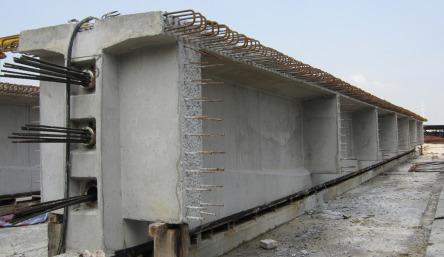
In post-tensioning systems, prestressing steel is positioned within ducts or sleeves cast into the concrete. After the concrete has been placed and allowed to cure, the steel is tensioned using hydraulic jacks, and the applied force is secured through mechanical anchorages. This approach allows compressive stresses to be applied selectively, offers flexibility in construction sequencing, and is well suited for long spans and in-situ construction. Post-tensioning is widely used in structural applications such as bridges, floor slabs, transfer girders, and other large-span structures.
Stress Distribution in Prestressed Concrete
One of the key advantages of prestressing steel is its influence on internal stress distribution within concrete members. In a typical prestressed concrete beam, the bottom fibers are placed in compression before any external loads are applied. When service loads act on the structure, they reduce this initial compression rather than inducing tensile stresses, which delays or, in many cases, eliminates cracking under normal operating conditions. This stress behavior improves fatigue resistance, enhances deflection control, and contributes to greater long-term durability of the structure.

Why Prestressing Steel Improves Structural Efficiency
Compared to conventional reinforcement, prestressing steel enables longer spans with fewer supports, reduced structural depth, and lower concrete volume while providing improved crack control and an extended service life. Together, these advantages contribute to lower lifecycle costs and more efficient use of materials across a wide range of structural applications.
Common Applications of Prestressing Steel
Prestressing steel is used across a wide range of structural applications, including bridge decks and girders, precast structural elements, industrial floors, high-rise building slabs, and energy and infrastructure facilities. These applications are common worldwide and are increasingly specified in complex projects delivered in Egypt, where structural efficiency, durability, and long-span performance are key design considerations.
Product Reference
For detailed technical data, applicable standards, and available configurations, refer to the prestressing steel product specifications on our website.
For sales enquiries or further information, click here to contact us. Our team can support product selection, applicable standards, sizing considerations, and logistics coordination for a wide range of prestressed concrete applications. For sales enquiry.