Stress–Strain Curves Explained for Structural Steel
Introduction
Stress–strain curves are one of the most fundamental tools in structural engineering and materials science. They describe how a material responds when subjected to tensile loading and provide critical information about elasticity, yielding, plastic deformation, and ultimate failure. For structural steel in particular, understanding the stress–strain curve is essential for safe design, code compliance, and material selection.
While stress–strain curves are often introduced in undergraduate mechanics courses, their relevance extends far beyond theory. They directly influence how structural members are proportioned, how safety factors are applied, and how materials such as reinforcing steel and prestressing strand are specified. This article explains stress–strain curves for structural steel in a clear and practical way, focusing on behavior that matters in real structural applications.
What Is a Stress–Strain Curve?
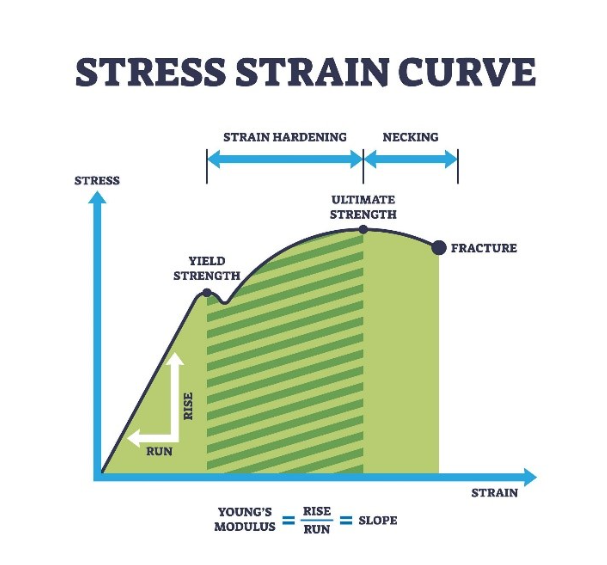
A stress–strain curve is a graphical representation of how a material deforms under applied load. The vertical axis represents stress, typically expressed in megapascals (MPa), while the horizontal axis represents strain, a dimensionless measure of deformation.
When a steel specimen is subjected to a tensile test, load is gradually increased until the material fractures. Throughout this process, stress and strain are recorded and plotted, resulting in a characteristic curve.
The Elastic Region
At the initial stage of loading, structural steel behaves elastically. In this region, stress and strain are proportional, and the material follows Hooke’s Law. The slope of this linear portion of the curve represents the modulus of elasticity (Young’s modulus), which is approximately 200 GPa.
Within the elastic region, deformation is fully reversible. If the load is removed, the steel returns to its original length without permanent deformation. This behavior is critical in structural design, as most service loads are intended to remain within the elastic range.
As a result, the stiffness of steel members in beams, columns, and slabs is directly related to this elastic portion of the stress–strain curve. Deflection calculations and serviceability checks are therefore based primarily on elastic behavior.
Yielding: The Transition to Plastic Behavior
However, as the applied stress continues to increase beyond the elastic limit, the material eventually reaches the yield point. Yield strength represents the stress at which permanent deformation begins. Beyond this point, the steel will not return to its original shape when unloaded.
In mild structural steels, a distinct yield plateau may appear, where strain increases at nearly constant stress. In contrast, higher-strength steels often do not display a clear plateau, and yield is defined using a 0.2% offset method, known as proof stress.
From a structural standpoint, yield strength is one of the most important material properties. It governs allowable stress levels and determines when a member transitions from elastic to plastic behavior. In reinforced concrete design, for example, rebar is often expected to yield in a controlled manner under ultimate loading conditions, providing ductility before failure.
The Plastic Region and Strain Hardening
Once yielding has occurred, structural steel enters the plastic region. In this range, additional strain develops with increasing stress, and deformation is no longer reversible.
As loading progresses further, the material undergoes strain hardening. During this stage, stress begins to rise again with increasing strain, even though the material has already yielded. This strain hardening effect increases the load-carrying capacity until the steel reaches its maximum stress, known as the ultimate tensile strength.
Importantly, the plastic region plays a critical role in structural behavior. It allows redistribution of stresses within a system, enabling ductile steel members to undergo significant deformation before failure. This capacity provides warning and energy absorption potential under extreme loading conditions.
Ductility and Structural Safety
Closely related to plastic behavior is the concept of ductility. One of the key characteristics of structural steel reflected in the stress–strain curve is its ability to deform plastically before fracture. Ductile materials exhibit significant plastic deformation prior to failure, which allows structures to redistribute stresses and provides visible warning signs before collapse.
For this reason, ductility is especially important in seismic design and dynamic loading conditions. Structural systems that rely on ductile steel behavior can absorb energy and undergo controlled deformation without sudden brittle failure.
While reinforcing steel used in concrete structures is typically designed to be highly ductile, prestressing steel behaves differently. Prestressing steel, such as PC Strand, operates at higher stress levels and relies more heavily on tensile strength and controlled relaxation characteristics rather than large plastic deformation capacity.
For further details on prestressing materials, refer to the PC Strand product specifications and the prestressing steel product range available on our website.
Application to Structural Steel Products
Different structural steel products exhibit variations in stress–strain behavior depending on composition and manufacturing processes.
Reinforcing bars typically show a pronounced yield point and significant ductility. Structural rolled sections exhibit predictable elastic and plastic regions consistent with design code assumptions. Prestressing steel, including high-strength strand, displays higher tensile strength and reduced ductility compared to conventional rebar, reflecting its specialized function in prestressed systems.
The stress–strain curve therefore serves as a unifying framework for comparing steel grades and selecting appropriate materials for structural performance requirements.
Sources and Further Reading
Callister, W. D., & Rethwisch, D. G. Materials Science and Engineering: An Introduction. Wiley.
ASTM A370 – Standard Test Methods and Definitions for Mechanical Testing of Steel Products.
EN ISO 6892 – Metallic Materials – Tensile Testing.
Nilson, A. H., Darwin, D., & Dolan, C. W. Design of Concrete Structures. McGraw-Hill.
Fédération Internationale du Béton (fib) Model Code for Concrete Structures.