Ductility vs Brittleness: Why Steel Fails the Way It Does
Overview
Steel is one of the most widely used structural materials in the world, valued for its strength, versatility, and reliability. Yet not all steel behaves the same way under stress. Some grades deform gradually before failure, providing visible warning signs. Others fracture suddenly with little or no prior deformation. The difference comes down to two fundamental material behaviors: ductility and brittleness.
Understanding why steel fails the way it does is essential for engineers, fabricators, and construction professionals who select materials for safety-critical applications. Whether specifying Concrete Reinforcement products or Drawn Wires for industrial use, the failure mode of the steel directly impacts structural safety and service life. This article examines the engineering principles behind ductile and brittle failure and explores how steel composition determines which failure mode a given product will exhibit.
What Is Ductility in Steel?
Ductility is a material’s ability to undergo significant plastic deformation before fracture. In practical terms, a ductile steel will stretch, bend, or neck visibly before it breaks. This behavior is critical in structural applications because it provides advance warning of failure, allowing time for inspection, load redistribution, or evacuation.
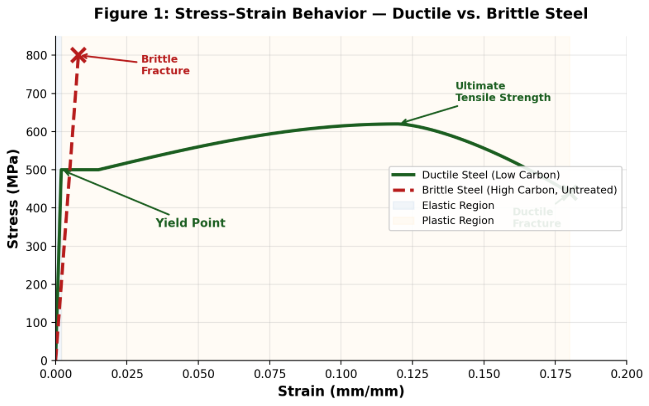
On a stress–strain curve, ductile steel exhibits a well-defined yield point followed by a long plastic deformation region before reaching ultimate tensile strength (see Figure 1 below). Products such as Reinforcement Steel Wire and Welded Wire Mesh are engineered to deliver this ductile performance, ensuring structural integrity under both static and dynamic loading conditions, including seismic events.
What Is Brittleness in Steel?
Brittleness is the tendency of a material to fracture with minimal plastic deformation. A brittle steel may sustain high loads but fails abruptly once its fracture threshold is exceeded. As shown in Figure 1, the brittle curve rises steeply but terminates without the extended plastic region that characterizes ductile behavior. There is little or no visible warning before failure, making brittle behavior particularly hazardous in load-bearing structures.
Brittle fracture is typically associated with low temperatures, high strain rates, stress concentrations, and certain microstructural conditions. It is characterized by a flat, granular fracture surface, in contrast to the rough, fibrous appearance of a ductile fracture.
How Steel Composition Affects Ductility
The balance between ductility and brittleness is largely governed by the chemical composition and microstructure of steel. As illustrated in Figure 2, increasing carbon content raises tensile strength but progressively reduces elongation at break. Several key alloying elements play a direct role:
Carbon: Carbon is the single most influential element in determining the strength–ductility balance (see Figure 2). Low-carbon steels (typically below 0.25% C) are highly ductile and easy to form, making them ideal for products like Reinforcement Steel Wire and Welded Wire Mesh. As carbon content increases, tensile strength rises but ductility decreases. High-carbon steels used in products such as PC Strand, PC Wire, and Tire Bead Wire are carefully processed through controlled cold drawing and stress relieving to achieve high strength while retaining the controlled elongation required for their respective applications.
Manganese: Manganese improves strength and hardness while helping to maintain ductility. It also counteracts the embrittling effects of sulfur by forming manganese sulfide inclusions, which are less harmful to the steel’s microstructure than iron sulfide. This is particularly important in the production of Galvanized Steel Wire and Black Wire, where consistent mechanical properties across long production runs are critical.
Sulfur and Phosphorus: Both elements are generally considered impurities. Sulfur promotes hot shortness and reduces ductility at elevated temperatures. Phosphorus increases strength but significantly reduces toughness and can cause cold brittleness. Tight control of these elements during steelmaking is essential for producing reliable, ductile products across our entire our full product range.
Silicon: Silicon acts as a deoxidizer during steelmaking and moderately increases strength. In controlled amounts, it supports ductility; however, excessive silicon can contribute to a harder, less ductile microstructure.
Why It Matters in Structural Applications
In safety-critical infrastructure such as bridges, buildings, and prestressed concrete elements, the failure mode of steel is as important as its strength rating. Ductile steel provides a margin of safety by absorbing energy and redistributing loads before fracture. This is why international standards for reinforcement and prestressing products — including those applied to PC Strand, PC Bar, and Welded Wire Mesh — specify minimum elongation values alongside tensile strength requirements.
At Elsewedy Steel, every product is manufactured under strict chemical and mechanical quality controls to ensure the optimal balance of strength and ductility for its intended application. From our Concrete Reinforcement segment to our Drawn Wires and Tire Reinforcement lines, we control raw material composition, processing parameters, and final testing to deliver steel products that perform predictably and safely throughout their service life. To explore our capabilities, visit our full product range.