Elastic vs Plastic Deformation in Steel
-
Introduction to Deformation in Steel
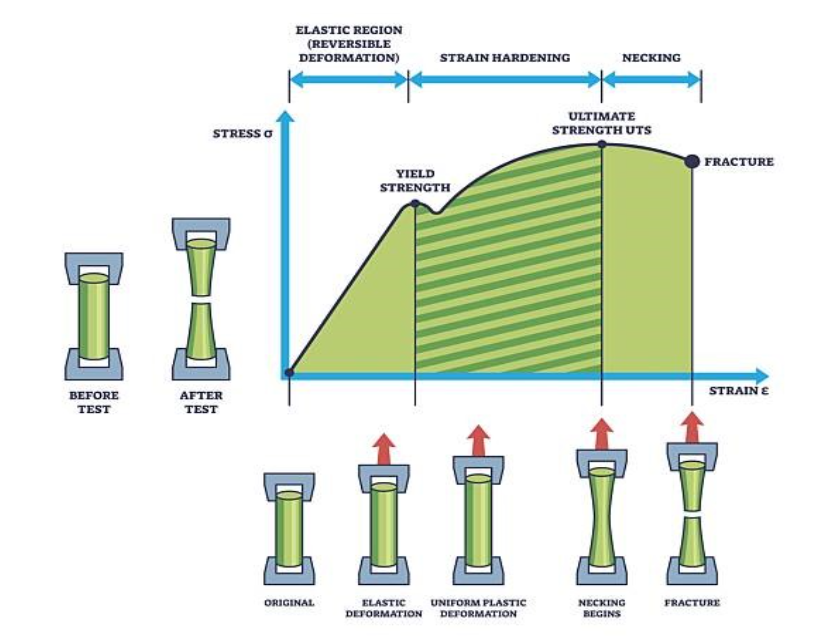
Steel is a structural material designed to carry load efficiently under tension, compression, and bending. Whether used in prestressed concrete, power transmission, or industrial manufacturing, understanding the mechanical behavior of steel is critical for safe and efficient structural engineering. However, the way steel behaves under load depends on whether it is in the elastic region or the plastic region of deformation. When a tensile load is applied to a steel wire, strand, or bar, it elongates. The relationship between applied stress and resulting strain is represented by the well-known stress–strain curve.
The stress–strain curve typically includes:
-
Linear elastic region
-
Yield point / proof stress
-
Strain hardening region
-
Ultimate tensile strength (UTS)
-
Necking and fracture
-
Elastic Deformation in Steel
In the elastic region, stress and strain are proportional (Hooke’s Law: σ = E·ε). Under service loads, steel behaves like a spring: it stretches but returns to original dimensions when unloaded. The elastic limit (yield point) is the maximum stress with fully recoverable deformation. Engineers use elastic behavior to control deflections, crack widths, and vibration. For example, prestressed concrete (PC) strands are tensioned within the elastic range so they don’t yield under service loads. PC Strands with high-tensile (e.g. 1,725–1,860 MPa grade) are produced to strict elongation and relaxation limits, ensuring they stay elastic during prestress transfer.
Key points about elastic deformation:
-
Temporary and Reversible: Material returns to its original length when load is removed. No permanent set remains.
-
Linear Stress–Strain: Stress ∝ strain, with constant slope = E.
For steel, (E ≈ 210 GPa) 1. Higher E means stiffer steel (resists deflection).
-
Proportional Limit: Marks the end of pure elasticity. Beyond this, microplasticity begins and full recovery fails.
In practical engineering terms, elastic behavior defines:
-
Serviceability performance
-
Deflection limits
-
Crack control in reinforced and prestressed concrete
-
Vibration control in structural systems
In practice, design loads are kept well below yield (often <60–70% of yield) to maintain elastic performance and safety. Codes and material specifications (ASTM, EN, BS) define allowable elastic limits for structures.
-
Plastic Deformation in Steel
When applied stress exceeds the yield point, steel enters the plastic region. Here the metal undergoes permanent deformation: part of the elongation remains after unloading. In a stress–strain curve, the material yields and then strain-hardens up to its ultimate tensile strength, then eventually fractures. Plastic deformation is not a flaw but a critical property for ductility and toughness.
Key features of plastic deformation:
-
Permanent Change: Material will not fully recover; it gains a “set” equal to the amount of plastic strain. Material loaded to a stress level greater than the elastic limit will experience some degree of permanent set. This is the essence of plastic flow.
-
Yield Strength (fy): The stress at which noticeable plastic deformation begins. For steels without a sharp yield plateau (mostly high carbon steel), a 0.1: 0.2% offset yield strength (Proof stress) is used.
-
Ductility: Steel’s ability to deform plastically before breaking (often several % strain). Ductility allows energy absorption in overload or seismic events. Low-ductility steel would fracture catastrophically; typical reinforcing steel wires are drawn to allow some plastic elongation.
Plastic behavior enables design safety margins. For instance, in reinforced concrete design, bending elements are allowed to crack and steel to yield, forming a ductile hinge rather than a sudden collapse. Thus, engineers often design for the ultimate limit state in the plastic range, ensuring failure is gradual.
In reinforced concrete systems, controlled plastic deformation:
-
Provides energy absorption
-
Prevents brittle failure
-
Enhances ductility
-
Improves seismic performance
Table 1. Comparison between elastic and plastic deformation
|
Feature |
Elastic Deformation |
Plastic Deformation |
|
Reversibility |
Fully reversible |
Permanent change |
|
Molecular Level |
Stretching of atomic bonds |
Breaking and reforming bonds |
|
Stress Limit |
Below Yield Point |
Above Yield Point |
|
Energy |
Stored as potential energy |
Dissipated as heat |
|
Structural Use |
Standard operating loads |
Safety margin/Failure prevention |
-
Engineering Applications
Different applications require different deformation behavior.
-
High tensile strength
-
Controlled elastic elongation
-
Low relaxation
-
Limited plastic deformation during service
-
Very high tensile strength
-
Fatigue resistance
-
Resistance to cyclic plastic strain
-
Moderate tensile strength
-
Higher ductility
-
Controlled plastic deformation under overload
The balance between strength and ductility is critical. If tensile strength is increased excessively without maintaining ductility, brittle failure risk increases.
-
References
-
World Auto Steel, the automotive group of the World Steel Association.
-
ASTM A416/A416M - Standard Specification for Low-Relaxation, Seven-Wire Steel Strand for Prestressed Concrete.
-
ASTM E8 / E8M — Tensile testing.
-
BS 5896: High tensile steel wire and strand for prestressed concrete.
-
prEN 10138 — Prestressing steel.
-
BS EN 10244-2- Steel Wire and Wire Products.