PC Strand vs Rebar: Key Differences in Structural Design
Introduction
In concrete structural design, the selection between PC Strand and conventional reinforcing bar (rebar) plays a decisive role in how a structure behaves under load, how cracking is managed, and how efficiently materials are utilized. Although both products are steel elements embedded in concrete, they function in fundamentally different ways and lead to distinct structural outcomes. Understanding the differences between PC Strand and rebar is essential for engineers, consultants, and contractors involved in infrastructure, industrial, and building projects across global markets.
This article presents a clear, engineering-focused comparison of PC Strand versus rebar, explaining how each system works within concrete, how stresses are distributed, and why prestressing is often selected for long spans and heavily loaded structures. The discussion focuses on structural behavior and design logic rather than product promotion.
Rebar in Reinforced Concrete Structures
Rebar is a carbon steel reinforcement used in conventional reinforced concrete to resist tensile stresses that concrete cannot carry on its own. It is placed within formwork before concrete is cast and becomes bonded to the concrete as it hardens. In reinforced concrete systems, concrete carries compressive stresses while rebar carries tensile stresses once cracking has occurred.
Cracking is an expected and accepted behavior in reinforced concrete design. Under bending or tensile loading, concrete cracks at relatively low stress levels, and the rebar begins to carry the tensile force across these cracks. While this approach is effective for many structural applications, it leads to visible cracking and increased deflection under service loads. Reinforced concrete with rebar is widely used in slabs, beams, columns, foundations, and walls across residential, commercial, and infrastructure projects.
PC Strand in Prestressed Concrete Structures
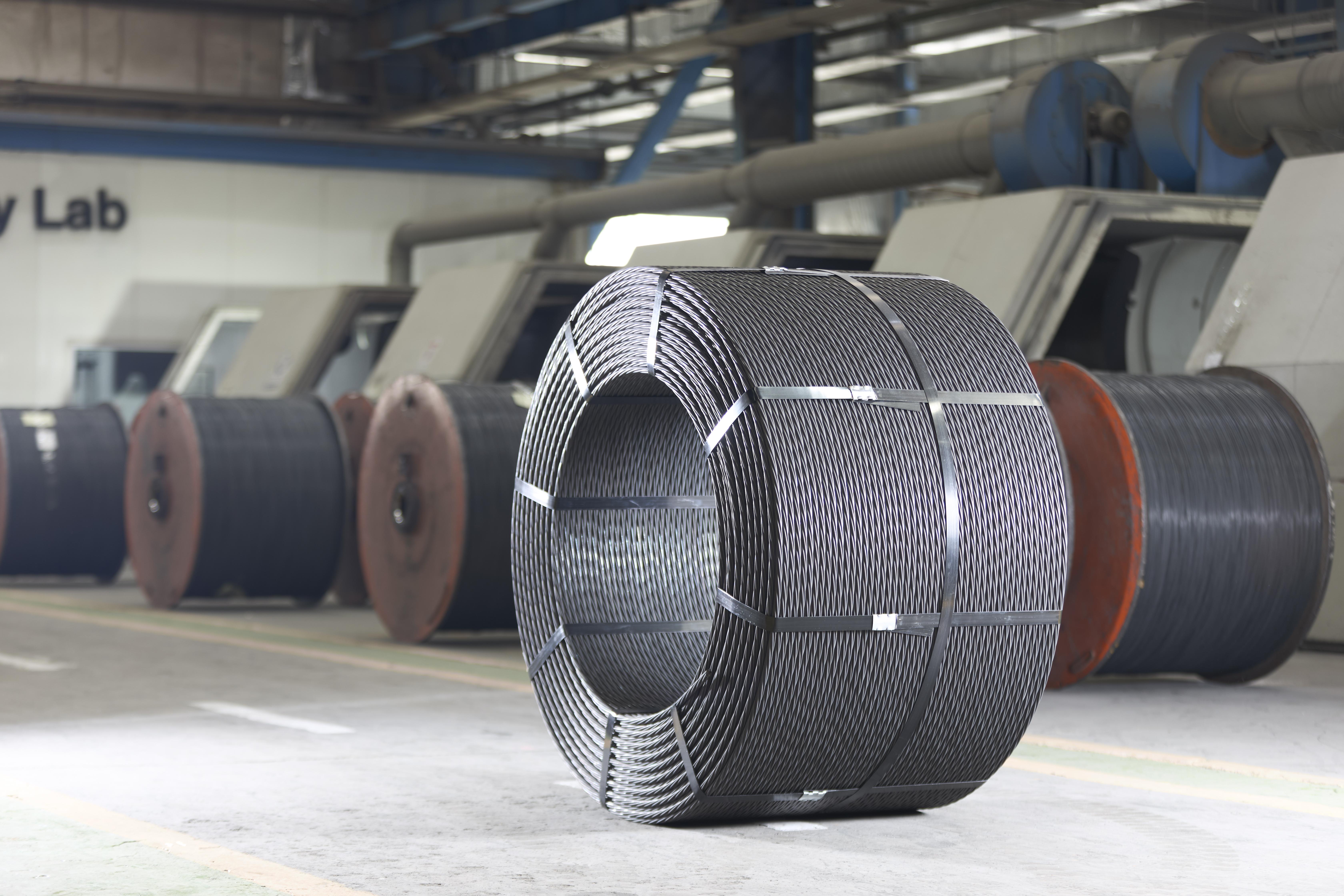
PC Strand, or Prestressed Concrete Strand, is a high-strength, cold-drawn steel product specifically designed to actively prestress concrete elements. The most common configuration is the seven-wire strand, consisting of a straight central wire surrounded by six helically wrapped outer wires. Unlike rebar, PC Strand is tensioned either before or after concrete casting, placing the concrete into a state of compression prior to service loading.
By introducing compressive stresses into the concrete, PC Strand fundamentally changes how the structure responds to applied loads. Tensile stresses that would normally cause cracking are counteracted by the pre-existing compression, resulting in improved structural performance. PC Strand is commonly used in pre-tensioned precast elements, post-tensioned slabs and beams, bridges, and long-span structures.
Passive Reinforcement Versus Active Prestressing
The primary difference between rebar and PC Strand lies in the timing and mechanism of force resistance. Rebar acts as a passive reinforcement, remaining largely unstressed until the concrete cracks and tensile forces are transferred to the steel. In contrast, PC Strand functions as an active reinforcement system by applying force to the concrete before external loads are introduced.
 This active prestressing approach allows concrete to remain largely uncracked under service conditions, improves stiffness, and significantly reduces deflection. As a result, prestressed concrete behaves differently from reinforced concrete even when subjected to similar loading conditions.
Stress Distribution and Structural Behavior
In a reinforced concrete member using rebar, bending loads generate tensile stresses in the concrete, leading to cracking at the tension face. Once cracks form, rebar carries the tensile force while the concrete continues to resist compression. This redistribution of stress results in increased deflection and long-term crack development.
In contrast, prestressed concrete members using PC Strand are pre-compressed along critical stress zones. When service loads are applied, these loads reduce the initial compression rather than creating tensile stresses. Cracking is therefore delayed or eliminated under normal operating conditions, resulting in better serviceability performance and improved long-term behavior.
Typical Applications
Rebar remains the preferred solution for many conventional applications such as low- to mid-rise buildings, foundations, columns, and shear walls. PC Strand is typically selected for bridges, precast structural elements, post-tensioned floor systems, transfer girders, and other structures where long spans, serviceability performance, and durability are critical.
In practice, both systems are essential, and the choice between PC Strand and rebar depends on structural requirements rather than preference.
Product Reference
For detailed technical data, applicable standards, and available configurations, refer to the prestressing steel product specifications on our website.
For sales enquiries or further information, click here to contact us. Our team can support product selection, applicable standards, sizing considerations, and logistics coordination for a wide range of prestressed concrete applications. For sales enquiry.